Every step was ‘pointless’
The objections changed with each device but sounded alike. In 1988, school districts from Dade County to Philadelphia banned students’ beepers; a Dade County schools official told the New York Times that the pager was “the most dominant symbol of the drug trade” (New York Times, “Schools Responding to Beeper, Tool of Today’s Drug Dealer, by Banning It,” 25 Sep 1988) (UPI, “Philadelphia schools ban phone beepers,” 24 Aug 1988).
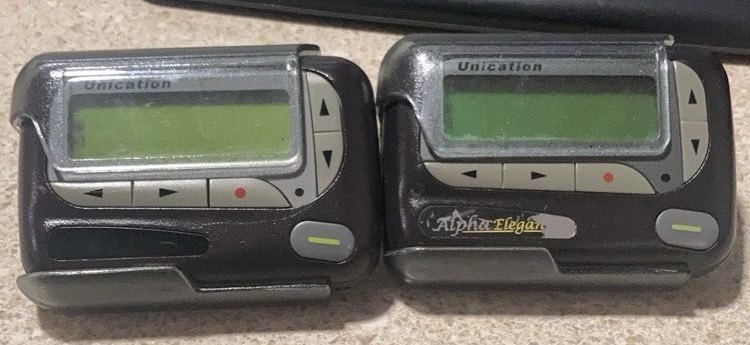
Photo: MohammedLombardia, via Wikimedia Commons. CC0 (public domain dedication).
The first handheld cellphone, Motorola’s DynaTAC 8000X, won FCC approval in 1983 and sold for $3,995 (Motorola Solutions, “Cell Phone Development” (company history)). At that price, a phone in the car or the hand looked like a status toy. In 1994, IBM and BellSouth’s Simon added a touchscreen, email and apps, for $899 with a two-year contract (Computer History Museum, IBM/BellSouth Simon Personal Communicator) (BBC News, “World’s first ‘smartphone’ celebrates 20 years,” 2014).
By 2002, 62% of U.S. adults owned a cellphone; today 98% do. Smartphone ownership went from 35% in 2011, when Pew first asked, to 91% (Pew Research Center, Mobile Fact Sheet (updated Oct 2026)). The common doubts along the way (too expensive, only for show-offs, “I have a computer at home”) were reasonable at each moment. They just didn’t last.
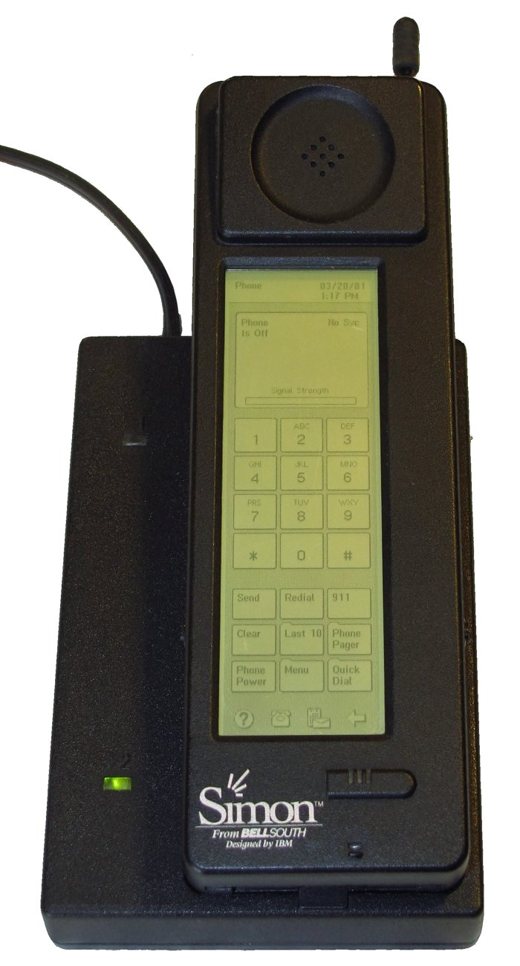
Photo: Bcos47, via Wikimedia Commons. Released into the public domain by the author.
No keyboard? No chance.
In November 2006, before Apple had shown a phone, Palm’s CEO Ed Colligan said: “PC guys are not going to just figure this out. They’re not going to just walk in” (MacRumors, citing the San Jose Mercury News, 21 Nov 2006).
After the January 2007 unveiling, a Bloomberg columnist called the iPhone “nothing more than a luxury bauble that will appeal to a few gadget freaks” (MacDailyNews, quoting Matthew Lynn’s Bloomberg column, 15 Jan 2007). Microsoft’s Steve Ballmer laughed on CNBC: “Five hundred dollars? Fully subsidized with a plan? … And it doesn’t appeal to business customers because it doesn’t have a keyboard” (CNBC, “Microsoft’s Ballmer Not Impressed with Apple iPhone,” 17 Jan 2007). In April he added: “There’s no chance that the iPhone is going to get any significant market share. No chance” (Ars Technica, quoting Ballmer’s USA Today interview, 30 Apr 2007).
BlackBerry’s co-CEO Jim Balsillie called it “one more entrant into an already very busy space,” and said calling it a sea-change for BlackBerry was “overstating it.” His co-CEO Mike Lazaridis said: “Try typing a web key on a touchscreen on an Apple iPhone, that’s a real challenge” (Fortune, “What the BlackBerry guys said as Apple ate their lunch,” 2011). In March 2007 a MarketWatch columnist urged Apple to “pull the plug” before launch (John C. Dvorak, “Apple should pull the plug on the iPhone,” MarketWatch, 28 Mar 2007).
Apple sold its millionth iPhone 74 days after launch (Apple Newsroom, “Apple Sells One Millionth iPhone,” 10 Sep 2007) and its billionth in 2016 (Apple Newsroom, “Apple celebrates one billion iPhones,” 27 Jul 2016). Its revenue went from $24.0 billion in fiscal 2007 (Apple Newsroom, fiscal 2007 fourth-quarter results, 22 Oct 2007) to $416.2 billion in fiscal 2025, of which $209.6 billion came from the iPhone alone (Apple Inc., Form 10-K for fiscal 2025 (SEC)).
From “Amazon.bomb” to Prime
Amazon listed in May 1997 at $18 a share (Amazon press release, IPO announcement, May 1997). On 31 May 1999, Barron’s ran a cover story titled “Amazon.bomb” (Barron’s, magazine contents for 31 May 1999 (“Amazon.bomb”)). It noted the shares had already fallen from 221¼ to 118¾ and argued they could fall much further (Barry Ritholtz, “Amazon.Bomb (May 31, 1999),” first published by Bloomberg, 2019).
On the price, Barron’s was right. The stock went on to drop roughly 95%, from over $100 in late 1999 to below $6 in 2001 (Barry Ritholtz, “Amazon.Bomb (May 31, 1999),” first published by Bloomberg, 2019). In June 2000, a Lehman Brothers analyst warned Amazon could run out of cash within a year; Amazon said it was “nowhere near running out of cash” (Wired, “Analysts Send Amazon Down River,” June 2000) (Los Angeles Times, “Amazon.com Shares Plummet 19%,” 24 Jun 2000).
The business kept growing through the crash. In February 2005 Amazon launched Prime: unlimited two-day shipping for $79 a year. Jeff Bezos admitted it was “expensive for the Company in the short-term” but said it would make two-day shipping “an everyday experience rather than an occasional indulgence” (Amazon press release introducing Amazon Prime, 2 Feb 2005).
Net sales were $1.64 billion in 1999 (Amazon press release, fourth-quarter and full-year 1999 results, Feb 2000) and $638.0 billion in 2024 (Amazon, fourth-quarter and full-year 2024 results, Feb 2025). The warehouses and delivery network that Prime required are now one of Amazon’s biggest advantages.
Vision versus the crowd
In both stories the people closest to the old way were the most confident it would last. Incumbents judged the new thing by the old measures: a keyboard, an email machine, business customers, quarterly profits. Users judged it by whether it made daily life easier.
Two cautions. Hindsight makes winners look obvious; plenty of confident bets of the same era failed. And timing matters: anyone who bought Amazon in 1999 waited years to break even. The edge is seeing where daily habits are heading, then sizing for the possibility that you’re early.
What the popular version gets wrong
Popular version The iPhone was the first smartphone.
What the record shows IBM and BellSouth’s Simon offered a touchscreen, email and apps in 1994 (Computer History Museum, IBM/BellSouth Simon Personal Communicator). BlackBerry and Palm phones were widely used before 2007 (MacRumors, citing the San Jose Mercury News, 21 Nov 2006).
Popular version Everyone laughed at the iPhone.
What the record shows Mostly incumbents and some columnists. Buyers didn’t: Apple sold a million in 74 days (Apple Newsroom, “Apple Sells One Millionth iPhone,” 10 Sep 2007).
Popular version The iPhone launched with the App Store.
What the record shows The App Store opened in July 2008, a year after the first iPhone (Apple Newsroom, “iPhone App Store Downloads Top 10 Million in First Weekend,” 14 Jul 2008).
Popular version Barron’s was simply wrong about Amazon.
What the record shows It was right about the stock for the next two years: the shares fell about 95% (Barry Ritholtz, “Amazon.Bomb (May 31, 1999),” first published by Bloomberg, 2019). It was wrong about the business.
What it means for today
We think voice is the next “no keyboard” moment. Typing to an AI agent is the bridge; talking to it is the destination. Models already hold real-time spoken conversations and call tools while they talk (OpenAI, Aug 2025), and Meta says AI glasses that see and hear what you do will become primary computing devices (Meta, Jul 2025).
The objections sound familiar: it’s awkward in public, it can’t replace a screen, it’s a toy. Amazon launched Alexa+, a generative-AI assistant that takes actions, in February 2025, free with Prime (Amazon, “Introducing Alexa+,” Feb 2025). Its CEO expects “billions of these agents” (Amazon, Jun 2025). See Personal AI agents.
The Future: Personal AI agents →
Companies we own that connect to this story (tickers only, never position sizes):
Sources
- Meta, Jul 2025
- Amazon, Jun 2025
- OpenAI, Aug 2025
- New York Times, “Schools Responding to Beeper, Tool of Today’s Drug Dealer, by Banning It,” 25 Sep 1988
- UPI, “Philadelphia schools ban phone beepers,” 24 Aug 1988
- Motorola Solutions, “Cell Phone Development” (company history)
- Computer History Museum, IBM/BellSouth Simon Personal Communicator
- BBC News, “World’s first ‘smartphone’ celebrates 20 years,” 2014
- Pew Research Center, Mobile Fact Sheet (updated Oct 2026)
- MacRumors, citing the San Jose Mercury News, 21 Nov 2006
- MacDailyNews, quoting Matthew Lynn’s Bloomberg column, 15 Jan 2007
- CNBC, “Microsoft’s Ballmer Not Impressed with Apple iPhone,” 17 Jan 2007
- Ars Technica, quoting Ballmer’s USA Today interview, 30 Apr 2007
- Fortune, “What the BlackBerry guys said as Apple ate their lunch,” 2011
- John C. Dvorak, “Apple should pull the plug on the iPhone,” MarketWatch, 28 Mar 2007
- Apple Newsroom, “Apple Sells One Millionth iPhone,” 10 Sep 2007
- Apple Newsroom, “iPhone App Store Downloads Top 10 Million in First Weekend,” 14 Jul 2008
- Apple Newsroom, “Apple celebrates one billion iPhones,” 27 Jul 2016
- Apple Newsroom, fiscal 2007 fourth-quarter results, 22 Oct 2007
- Apple Inc., Form 10-K for fiscal 2025 (SEC)
- Barron’s, magazine contents for 31 May 1999 (“Amazon.bomb”)
- Barry Ritholtz, “Amazon.Bomb (May 31, 1999),” first published by Bloomberg, 2019
- Wired, “Analysts Send Amazon Down River,” June 2000
- Los Angeles Times, “Amazon.com Shares Plummet 19%,” 24 Jun 2000
- Amazon press release, IPO announcement, May 1997
- Amazon press release, fourth-quarter and full-year 1999 results, Feb 2000
- Amazon press release introducing Amazon Prime, 2 Feb 2005
- Amazon, fourth-quarter and full-year 2024 results, Feb 2025
- Amazon, “Introducing Alexa+,” Feb 2025
- Wikimedia Commons, “Pagers.jpg” (CC0)
- Wikimedia Commons, “IBM Simon Personal Communicator.png” (public domain)
Last reviewed: 22 Oct 2026. Historical figures are quoted as the sources publish them; where sources disagree, we say so.
Not investment advice. History is a lens, not a forecast. This page is opinion and education, researched and presented with the help of AI analyst personas, and may contain errors. The EarlyConviction team holds positions in AMZN, META, NVDA and may buy or sell at any time. Read the disclaimer.