Blocked in Parliament
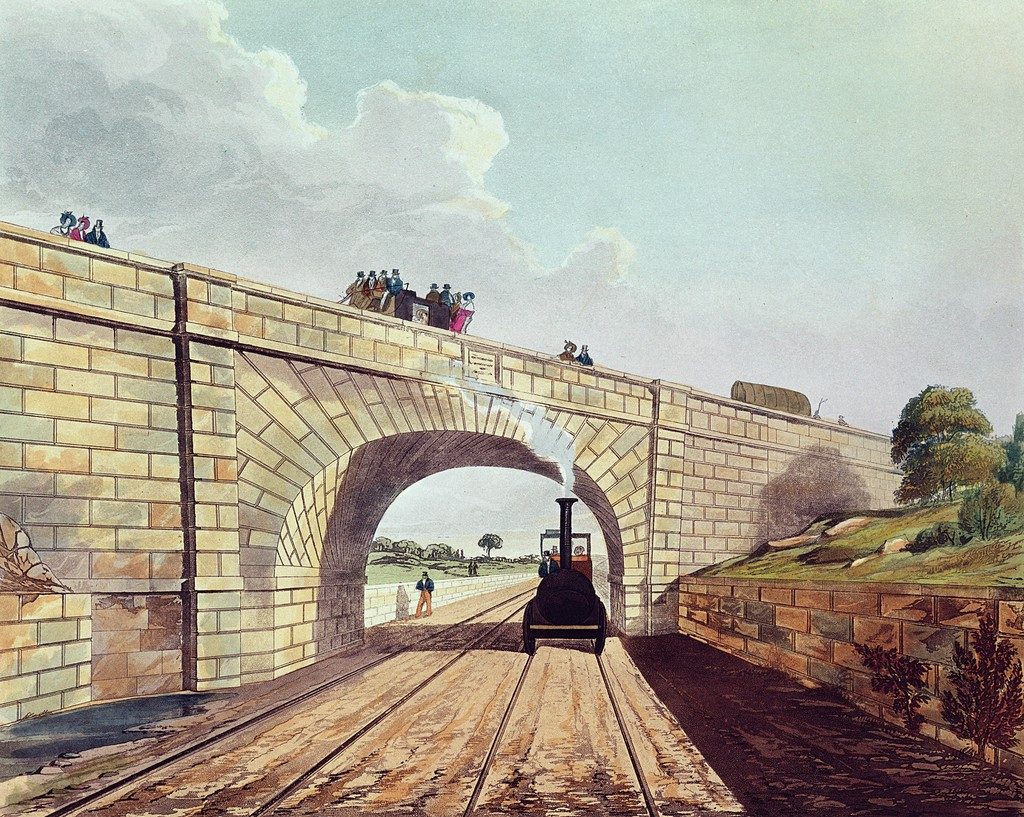
Henry Pyall after Thomas Talbot Bury, published by Ackermann, 1831. Via Wikimedia Commons. Public domain.
The Liverpool and Manchester Railway’s first bill was withdrawn in 1825. The owners of three rival waterways, including the Duke of Bridgewater’s Canal, set aside their own squabbles to oppose it, joined by two earls whose estates lay on the route (Railway & Canal Historical Society, The Liverpool & Manchester Railway (Holt)). Their expert witnesses exposed real errors in George Stephenson’s survey, with levels off by as much as 30 feet (Science Museum Group, Stephenson’s 1824 route plan). The promoters picked a new route and neutralised the most powerful opponent by letting the Bridgewater trustee subscribe for 1,000 shares. The new Act received Royal Assent in May 1826 (Railway & Canal Historical Society, The Liverpool & Manchester Railway (Holt)) (Hansard, House of Commons, 6 Apr 1826, Liverpool and Manchester Railway Bill). The canal owners had good reason to worry; see Canals and railroads.
A tragic first day
At the opening on 15 September 1830, William Huskisson MP stepped onto the line and was run down by Stephenson’s Rocket. He died of his injuries (Science Museum Group, letter on the opening of the Liverpool & Manchester Railway). It became the most famous early railway accident.
The Lancet investigates
By 1862 the medical journal The Lancet had commissioned a study of “The Influence of Railway Travelling on Public Health” (The Lancet, 4 Jan 1862, Report of the Commission). It noted that public worry had shifted from fear of accidents to “a vague dread of certain undefined consequences” to health (The Lancet, “The Influence of Railway Travelling on Public Health,” 1862 (full text)).
The report examined vibration, noise, ventilation, eye strain and nervous fatigue, and even discussed the “rapid aging of season-ticket holders” (The Lancet, “The Influence of Railway Travelling on Public Health,” 1862 (full text)). Its stated aim was to replace “loose inferences and vague surmises” with exact knowledge (The Lancet, “The Influence of Railway Travelling on Public Health,” 1862 (full text)).
What the popular version gets wrong
Popular version Doctors warned that speed itself would kill passengers.
What the record shows The best-known medical inquiry focused on fatigue, nerves, vibration and comfort, and set out to replace surmise with data (The Lancet, “The Influence of Railway Travelling on Public Health,” 1862 (full text)).
Popular version Opposition to railways was mostly about safety.
What the record shows The opposition that stopped the 1825 bill came from canal owners and landowners, who used real flaws in the survey; it ended when the biggest canal interest was given a stake (Railway & Canal Historical Society, The Liverpool & Manchester Railway (Holt)) (Science Museum Group, Stephenson’s 1824 route plan).
What it means for today
Self-driving cars face the same two forces: incumbents with a lot to lose, and public unease that only data and experience can settle. Both railways and cars suggest the data wins over time. See Autonomous cars.
Companies we own that connect to this story (tickers only, never position sizes):
Sources
- Hansard, House of Commons, 6 Apr 1826, Liverpool and Manchester Railway Bill
- Railway & Canal Historical Society, The Liverpool & Manchester Railway (Holt)
- Science Museum Group, Stephenson’s 1824 route plan
- Science Museum Group, letter on the opening of the Liverpool & Manchester Railway
- The Lancet, “The Influence of Railway Travelling on Public Health,” 1862 (full text)
- The Lancet, 4 Jan 1862, Report of the Commission
- Wikimedia Commons, “Rainhill Bridge” (Bury, 1831)
Last reviewed: 22 Oct 2026. Historical figures are quoted as the sources publish them; where sources disagree, we say so.
Not investment advice. History is a lens, not a forecast. This page is opinion and education, researched and presented with the help of AI analyst personas, and may contain errors. The EarlyConviction team holds positions in TSLA, NVDA and may buy or sell at any time. Read the disclaimer.